 Ever since I was a child and started to watch robots such as Voltes V, Mazinger Z, Daimos and other robots in movies. I was fascinated and at the same time curious about how does it really works. I used to wreck all my toys just to find the answer to my question, but to my dismay the answer was still aint there. Years passed and I took Electronics Engineering Technology(ESET) at Technological University of the Philippines (TUP) because of the fact that i was still amazed how robots work. I graduated after 10 years studying in college but never did I found the answer. This is the closest thing to the answer, and still I'm not contented.
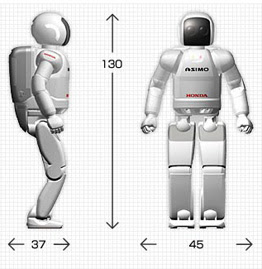
ASIMO Humanoid Robot ASIMO (Advanced Step in Innovative MObility) is a bipadel humanoid robot from Honda . This robot has been evolving since its inception in 1986. Current version of ASIMO is 1.2 meter tall and weighs 43 Kg. This size enables ASIMO to actually perform tasks within the realm of a human living environment. It also walks in a smooth fashion which closely resembles that of a human being. Advanced Walking Technology Predicted Movement Control (for predicting the next move and shifting the center of gravity accordingly) is combined with existing walking control know-how to create i-WALK (intelligent real-time flexible walking) technology, permitting smooth changes of direction.
Walking by putting one
 leg before the other was successfully achieved. However, taking nearly five seconds between steps,it walked very slowly in a straight line.To increase walking speed, or to allow walking on uneven surfaces or slopes, fast walking must be realized.
The New ASIMO has made great leaps forward from its predecessor. In fact, the New ASIMO can walk along with you (holding your hand if you wish), and features advanced mobility, to the extent that ASIMO can now move carts and other objects around at will. And, with a newly developed total control system that controls all of ASIMO's functions, ASIMO can autonomously act as a receptionist, or even deliver drinks on a tray. The New ASIMO is also more agile than before, being able to run at 6km/h, and even turn whilst running.
Major Features
Receptionist tasks
ASIMO is now capable of performing tasks as a receptionist or information guide automatically in concert with the movement of people. ASIMO now has the ability to recognize the surrounding environment through visual sensors, floor surface sensor, ultrasonic sensor, and by an IC Tele-interaction Communication Card, developed independently by Honda, held by the person with whom ASIMO will interact. Head-mounted eye camera and force (kinesthetic) sensor-equipped wrists allow ASIMO to give and receive an object such as a tray in a timely manner, or even to hold the hand of a person and move in sync.
Carrying objects
ASIMO is now capable of handling a cart freely while maintaining an appropriate distance from the cart by adjusting the force of its right and left arms to push a cart using the force (kinesthetic) sensor on its wrists. Even when the movement of the cart is disturbed, ASIMO can continue maneuvering by taking flexible actions such as slowing down or changing directions.
Improved mobility
Normal walking speed:2.7km/hour (previous model: 2.5km/hour)Walking speed while carrying objects:1.6km/hour(based on carrying object: weighing 1kg)Running speed:6km/hourSpeed of running in a circular pattern:5km/hour (2.5m radius)
Receptionist tasks
ASIMO is now capable of performing tasks as a receptionist or information guide automatically in concert with the movement of people. ASIMO now has the ability to recognize the surrounding environment through visual sensors, floor surface sensor, ultrasonic sensor, and by an IC Tele-interaction Communication Card, developed independently by Honda, held by the person with whom ASIMO will interact. Head-mounted eye camera and force (kinesthetic) sensor-equipped wrists allow ASIMO to give and receive an object such as a tray in a timely manner, or even to hold the hand of a person and move in sync.
Carrying objects
ASIMO is now capable of handling a cart freely while maintaining an appropriate distance from the cart by adjusting the force of its right and left arms to push a cart using the force (kinesthetic) sensor on its wrists. Even when the movement of the cart is disturbed, ASIMO can continue maneuvering by taking flexible actions such as slowing down or changing directions.
Improved mobility
Normal walking speed:2.7km/hour (previous model: 2.5km/hour)Walking speed while carrying objects:1.6km/hour(based on carrying object: weighing 1kg)Running speed:6km/hourSpeed of running in a circular pattern:5km/hour (2.5m radius)


